Related

Off-Season Dryland Training
Off-Season Dry Land at Prospect Lab
The off-season isn't for sitting on the couch or just playing summer league games.
If you want your athlete to show up to training camp faster and stronger than they left, you have to get them off the ice and into the gym.
Dry land training for youth hockey is where the real gains happen.
On the ice, players are limited by their skating mechanics and the cold environment.
In the gym—specifically on our 2,000 sq. ft. of turf—we can break down their movement, fix power leaks, and build the engine they need to dominate the third period.
At Prospect Lab, we use vertical jump tests, force transfer assessments, and speed measurements to show your kid is improving through training with us.
Why can't hockey players just train on the ice?
The ice is great for skill, but it's a poor place to build raw strength and power. To be great, athletes must dominate the fundamentals of strength, power, and speed. Strength is the foundation. Stronger kids hit harder, shoot faster, and get injured less often.
Dry land training allows us to focus on:
- Force Transfer: Teaching athletes how to move energy from the ground through their core and into their stick or stride.
- Symmetrical Development: Hockey is a game of imbalances. Players lean to one side or constantly rotate in one direction. Using single-leg exercises like Bulgarian split squats and lunges helps us iron out these differences before they lead to injuries.
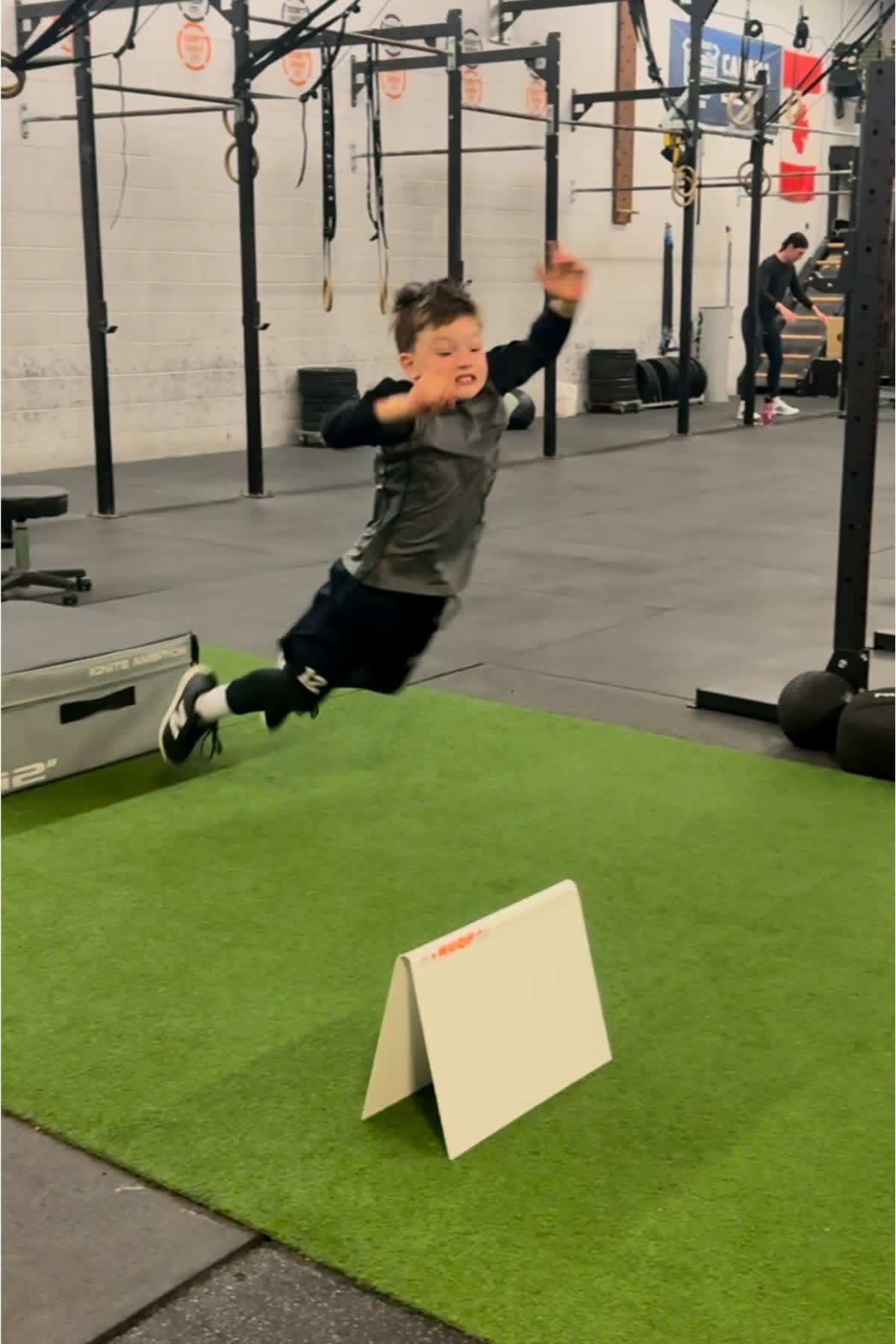
- Explosive Power: You can't maximize a vertical jump or a 90-foot sprint while wearing skates. We use sleds, hurdles, and med balls to build that first-step explosiveness.
Does off-ice training prevent hockey injuries?
Yes, but only if it's done right. We recently ran movement screenings for local AAA teams and found a massive trend of knee valgus (knees caving in) and quad-dominant patterns. These are red flags for ACL stress and hip adductor strains.
Our dry land programs prioritize:
- Landing Mechanics: Teaching kids how to absorb force softly so their joints don't take the hit.
- Posterior Chain Strength: Getting athletes out of their quads and into their glutes and hips.
- Core Stability: Building a trunk that can handle the dynamic nature of the sport.
What does a Prospect Lab off-season look like?
Your athlete starts with a plan to measure their current performance and test improvements.
- Spring/Early Off-Season: Focus on building a massive strength base with compound lifts like squats and presses. Weights are built up slowly and appropriately for each age group.
- Summer/Pre-Season: Transition that strength into speed. We move to ladder drills, reaction drills, and high-intensity conditioning intervals to ensure they’re game-ready for the fall.
We are a high-performance hub located at 427 Speers Rd in Oakville. If your boy or girl is ready to put in the work to become a stronger, more capable human, on and off the ice, we’re ready to coach them.
Contact us today to reserve your summer time slot.
.png)